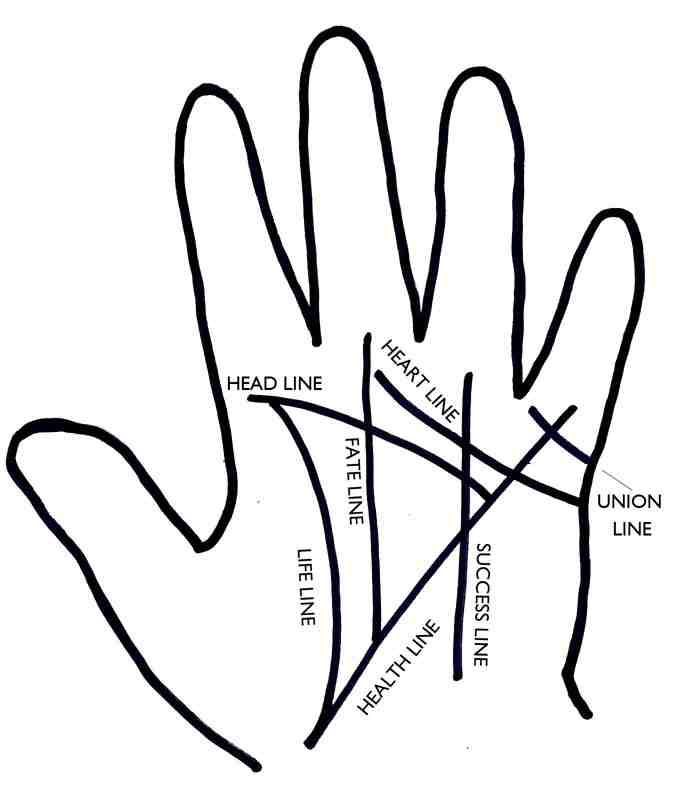
Palmistry is the art of reading character and destiny from the shape of the hand and the lines of the palm. It is not fortune-telling but about knowing yourself and where you are going. The palm gives us a map of our life and it is up to us to make the most of it: through self-awareness we can shape our fate and affect our future.
If you imagine that we all possess different energies and the palm shows us the way they flow. So, for example, you could be a very creative person but you are doing a very monotonous job. You are bored because you are not in tune with your true nature. But this changes when you have a job that uses that creative side. There is no right or wrong answer: just finding the things in life that make you happy and contented.
It is important to note that the lines of the hand can change, for better or for worse. Nothing is set in stone and we have free will to change our future. Life is what we make it.
LEFT OR RIGHT-HANDED?
The hand you use is called the major, or outer hand. This indicates any future events, as well as what you are like on the outside.
The other hand is the minor, or inner hand. This shows your potential, as well as what you are like on the inside.
Right-handed people tend to be more logical because that part is connected to the analytical, left side of the brain.
Left-handed people tend to be more creative because that part is connected to the intuitive, right side of the brain.
HOW DOES IT FEEL?
The texture and feel of the hand is important in an initial assessment. Is it soft? Or hard? Does it bend easily under pressure or is it very rigid? The job has no relevance to the feel of the hand: manual workers can have soft hands and office workers can have hard hands.
People with really soft hands are refined, sensitive and prefer genteel activities. Hard-skinned people are tough and prefer plenty of activity and concrete matters.
Some people’s hands are really pliable and bendy: this indicates an easy going and flexible nature. If you have really stiff hands this shows a determined/stubborn nature. You tend to hold your ground!
The length of the fingers supplies various information about the character. A long-fingered person is analytical and academic, liking to study things in detail. A person with markedly short fingers is very practical and intuitive, liking to go with their gut instinct. When the hands are in proportion it shows a balanced personality. | ||
| A balanced ego is indicated when the forefinger reaches the bottom of the nail of the middle finger. |
| Balanced emotions are indicated when the ring finger reaches the bottom of the nail of the middle finger. |
| Great confidence is indicated when the fore finger reaches past the bottom of the nail of the middle finger. |
| Very emotional and creative impulses are indicated when the ring finger reaches past the bottom of the nail of the middle finger. |
| A lack of confidence is indicated when the fore finger doesn’t reach past the bottom of the nail of the middle finger. |
| Blocked emotions are indicated when the ring finger doesn’t reach past the bottom of the nail of the middle finger. |
| When the middle finger is prominent, standing out from the rest, it shows a serious and intense nature. |
| When the little finger stands out naturally from your hand it shows an independent and outspoken nature. |
The thumb, nails and fingerprints are very important in hand analysis. This guide is too brief for a detailed explanation. | ||


WEARING RINGS
Rings on the fingers can indicate character traits.
Forefinger: Overbearing ego; or compensating for a lack of confidence.
Middle finger: Materialistic nature; needing security.
Ring finger: This is conventional and is only noted if there are multiple or large rings adorning it. If this is the case then emotional or creative frustration could be present.
Little finger: It is common to see this in the gay community, especially on the left-hand. Otherwise you'll see a lot of businessmen, showbiz people, and anybody else who likes to accumulate fame, status and money.
The affect of the rings is enhanced if they are on both hands, and by their size.
A hand covered with jewellery shows emotional armour: the person is hiding behind their rings, finding it hard to be themselves.
The life line travels around the thumb. This tells us about the subject’s physical health: the stronger the line the better the physical constitution. If the line looks weak and frayed then it could be a sign of delicate health. Again it is worth noting that we can’t make a deduction from one line alone as other markings might compensate the weakness. | ||
| ||
| ||


The Head line has the same starting point as the life line (near the thumb) and then goes across the palm. It shows the the way you think. The longer it is the more potential you have. And the clearer it is the more strong-minded / focused you are. | ||
| A straight head line shows a practical and logical person. They can be over-analytical, especially when it comes to love. |
| |
 | A gently curving head line shows a balance between the practical and the creative. They have their feet on the ground and are flexible enough to adapt. | |
| A steeply curving head line shows a very imaginative and creative person. They have plenty of ideas and inspiration but can find it difficult to keep their feet on the ground. |
| |
 | A short head line that doesn’t go past the middle finger shows a focused nature. But they can find it difficult to see past their needs. | |
| A head line with a fork at the end of it (underneath the ring finger) is called a writer’s fork. Even if you don’t write it shows a versatile and adaptable nature. A fork underneath the little finger shows acumen in business or science. |
| |


HEART LINE | ||
| The heart line stands for your emotions. It starts from the edge of the hand (from the little finger side) and travels across the top of the palm. It is especially important when it comes to relationships. | ||
| When the heart line ends between the forefinger and the middle finger it means you are emotional and passionate. |
| |
 | When the heart line ends underneath the middle finger it means that you can be self-centered in relationships and need to consider your partner more. | |
| When the heart line travels across the top of the hand it means you are more interested in the mental side of the relationship. You don't like great displays of emotion. |
| |
 | When the heart line is short and doesn't go past the middle finger it means you are very cool with your emotions and the physical side is the most important thing in relationships. | |
| When the heart line ends in a fork it shows a balance with your emotions: you are very adaptable in that sphere. |
| |


HEART / HEAD LINE COMBINATIONS The lines have various markings on them. Our guide is too brief to examine them in detail but we will see how these two lines are inter-related to each other. This modifies the meaning and gives texture to the interpretation. | ||
| When the heart line appears low in the hand and looks like it’s pushing down on the head line, it means that you are ruled by your emotions. |
| |
 | When the head line appears high in the hand and looks like it’s pushing up on the heart line, it means that you are ruled by your intellect. | |
| The gap between the heart line and the head line is called the quadrangle. When it is narrow it means you could be close-minded. |
| |
 | When the quadrangle is wide it means you are probably open-minded. If the quadrangle starts narrow and gets wider it means you become more open as you get older. The gap between the beginning of the head line and the life line is significant. A wide space means an independent nature from an early age. If the two lines are tied together it means a cautious nature-especially if they look chained which means shyness. | |


There are numerous other features on the palm and we will have a brief look at them. They are usually not as clearly marked as these examples but they will illustrate the point. | ||
| ||
| ||
| The hand is an amazing instrument: it has 27 small bones and 37 skeletal muscles attached to them by tendons. It is the most sensitive part of the body and, in proportion, takes up the most space in the brain. This is directly linked to the palm which acts like a computer print-out of our life: we can see our character and destiny in the map of our hand. | ||